
Design and manage experiments with industrial discipline.
Plan, execute, document, and analyse designed experiments so process learning becomes repeatable organisational knowledge.
Process Optimization Experiments
Conduct design of experiments trials under plant conditions with structured engineering logs.
Factorial Experiment Plans
Design trial runs with varied settings (speed, feed, heat) to map outputs.
Improvement: Finds sweet spot parameters.
Standard Execution Guides
Instruct line operators on specific trial conditions to avoid setup bias.
Improvement: Validates test criteria.
Knowledge Base Library
Retain test histories so engineering learnings aren't lost to turnover.
Improvement: Preserves R&D assets.
Response Surface Mapping
Plot yield results dynamically to identify optimal process windows.
Improvement: Maximizes yield gains.
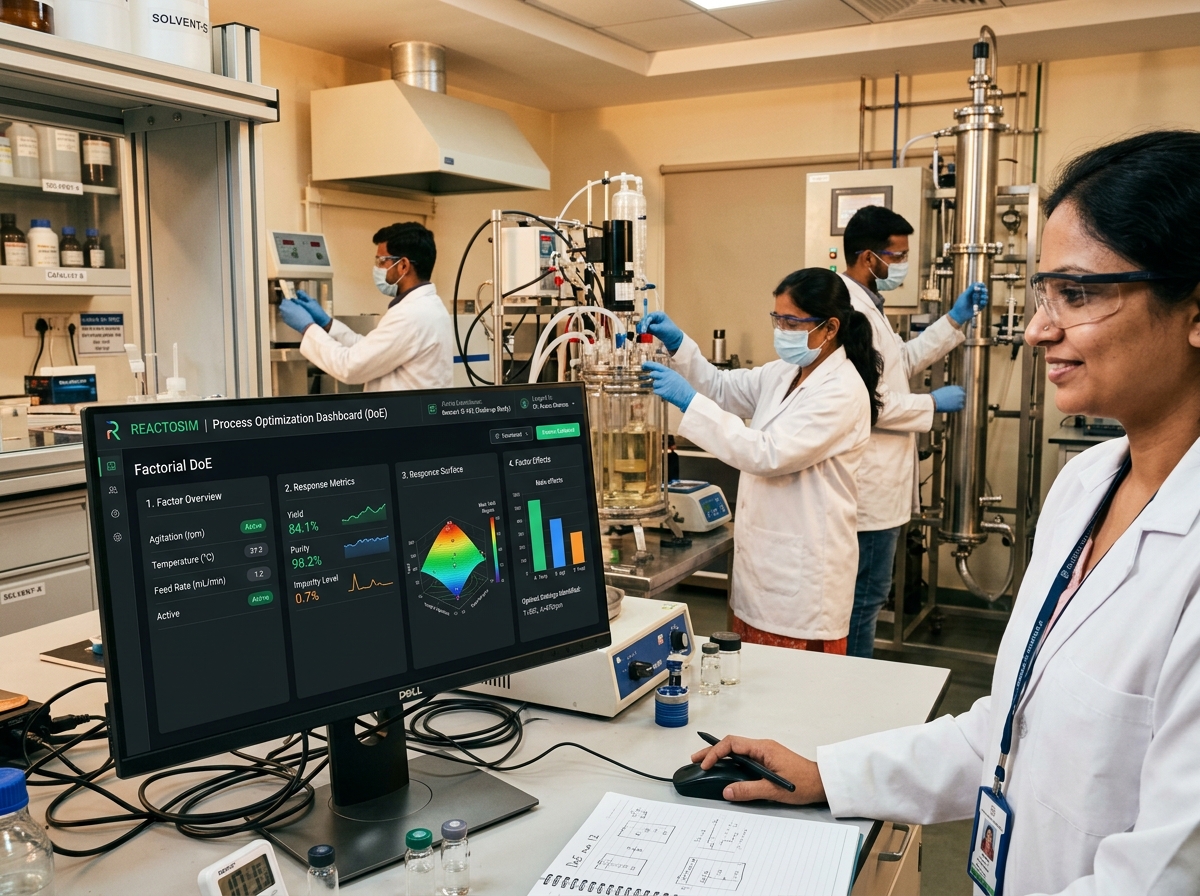
Design of Experiments (DoE) Hub
Configure optimization experiments, input variables, and trials on a central engineering board.
Factor Setup
Configure input variables and level ranges for experiments.
Design Options
Support full, fractional factorial, Box-Behnken, and Taguchi matrices.
Constraint Checks
Identify and prevent hazardous parameter settings.
Result Logs
Record output metrics (e.g. strength, viscosity) for each trial.
Approval Signatures
Collect sign-offs from process managers before starting trials.
ANOVA Calculations
Partition variance to identify key parameter contributions.
DOE-2026: Extrusion Heat & Speed
6-Step Process Optimization
Define objectives, configure factor sets, generate trial plans, execute trials, analyze results, and publish recipes.
Objective Definition
Define optimization goals (e.g. increase yield, reduce defect rates).
Log Trial Results
Step-by-step entry for operators to log parameter values and observations during trials.
Operator Guidance
Provide clear parameter instructions for each trial run.
Limit Checks
Flag and prevent out-of-safety-limit inputs.
Photo Attachments
Attach photos of trial components for records.
Offline Capture
Log trial measurements offline; sync once connected.
Record Trial Run
Select Trial Run
Run #4: Temp 160°C, Speed 15m/s
Record Readings
Enter surface roughness: 0.12 microns
Verify Compliance
Confirm trial stayed within safety limits
DoE Trial Calendar
Due TodayExtruder Temp Trial Run
Line 4 Extruder • Run #5-8 • Operator check
Mixer Impeller Test
Line 3 Mixer • Run #1-4 • Technician check
Trial Calendars
Plan and track experiment timelines and approvals to ensure trials are executed on schedule.
Schedule Alerts
Notify team members when trial schedules are reached.
Approvals Workflows
Collect manager sign-offs before commencing trials.
Material Planning
Coordinate raw material releases with trial schedules.
Calendar Views
View all scheduled trials in a unified planner.
Trial Process Deviations
Log instances where trial runs exceed safety or quality limits, halting experiments.
Safety Halts
Halt experiments immediately when safety thresholds are breached.
Deviation Logs
Record parameter histories leading up to anomalies.
Supervisor Alerts
Send anomaly reports to plant supervisors automatically.
CAPA Integration
Verify corrective actions are completed before restarting trials.
Trial Exception Log
DOE-ERR-02Trial Parameter Excursion
Aug 13, 2026 • 11:45 AM168°C
Excursion Value (Max 165)Run 4
Affected RunDetails
Core temperature spiked past safety limits during trial run #4. Trial immediately halted. Safe state verified.
Trial RCA File
RCA-DOE-025 Whys Trace
Trial Defect Analysis
Audit failed trials to identify root causes and optimize safety limits.
Fault Correlations
Analyze historical sensor readings to identify drifts.
5 Whys Logging
Log structural explanations next to trial records.
CAPA Workflows
Generate gauge calibration tasks directly from root causes.
Insight Archive
Search past RCA records to resolve similar process anomalies.
Supported DoE Methods
Select from multiple design of experiment techniques depending on variable counts.
Factorial Designs
Evaluate multiple variables and interactions simultaneously.
Response Surface Methods (RSM)
Optimize parameters by mapping multidimensional response curves.
Taguchi Methods
Optimize quality and stability under varying operating conditions.
Screening Designs
Identify key variables from hundreds of potential inputs.
Connected DoE Pipeline
Connect experimental designs with active control plans, historians, and registers.
Historian Data
Import trial parameter values from historian databases automatically.
Control Plans
Publish optimized setpoints to control plans automatically.
LIMS Platforms
Link trial runs directly with laboratory test results.
Asset Registry
Log trial histories and parameter levels against physical assets.
Numbers from real engagements.
Bring structure to test-and-learn work on products and processes.
Preserve how trials were run rather than relying on individual memory.
Turn results into controlled, usable guidance for the next team.
Built for teams that need this to just work.
Who this is for
- Process and R&D Engineers designing structured experiments to optimize product quality.
- Quality Assurance Teams validating process windows and operating boundaries.
- Plant and Operations Managers who need permanent, documented trial records rather than tribal knowledge.
- Manufacturers transitioning from trial-and-error testing to structured, repeatable DOE methodologies.
The operational building blocks your team needs.
Configure experimental inputs and responses, compile trial matrices, enforce safety thresholds, and store analysis records.
Experiment planning
Define factors, responses, constraints, trial plans, and owners before a production experiment starts.
Execution records
Capture observations and results against the approved experimental conditions.
Knowledge library
Retain experiment history, findings, and validated settings for future engineering work.
From the shop floor to the leadership view.
Enforce safety boundaries, guide operators through active trials, and convert validated setups into standard settings.
Log Trial Run
Guide operators through active trial parameters and capture results directly at the workstation.
Safety Halts
Automatically halt experiments and alert supervisors if process telemetry breaches safety thresholds.
ANOVA & Analytics
Calculate main effects, interaction curves, and response surfaces directly from logged results.
Standard Settings
Convert optimal, validated factor setpoints into standard operating procedures automatically.
Experiment Approvals
Require manager reviews and safety signs before releasing experiment matrices to the line.
Knowledge Registry
Archive all past trials, designs, and statistical outcomes in a central, searchable library.
A repeatable path, every time.
1. Discover Scope (Weeks 1-2)
Identify the target process, define experimental objectives, and list critical factors (inputs) and responses (outputs).
2. Configure Safety (Weeks 3-4)
Set up the DoE hub with factor limits, safety constraints, operator logging views, and trial matrix templates.
3. Launch Trial Pilot (Weeks 5-6)
Execute a full, structured experiment cycle on a single production line, validate operator logging, and run initial analysis.
4. Scale Registry (Weeks 7-8)
Roll out the structured experimentation workflow across remaining lines and plants to establish a central, searchable trial registry.
Industrial technology your operation can rely on.
We combine industrial data, connected workflows, and secure integrations to make this solution practical for real plant operations.
Factor/Response Model
DoE Hub configuration
Statistical Engine
ANOVA & RSM calculation
AI Experiment Designer
Trial optimization generator
The questions we hear most.
Which experimental design types are supported (factorial, RSM, Taguchi)?+
We support Full and Fractional Factorial designs, Response Surface Methodologies (RSM like Box-Behnken and Central Composite), and Taguchi Orthogonal Arrays depending on your variable count and trial budget.
Can this calculate ANOVA and interaction effects automatically?+
Yes. Once trial run response measurements are logged, our statistical engine automatically performs Analysis of Variance (ANOVA), generates main effects/interaction plots, and calculates regression models.
How are safety limits enforced during trial runs?+
Safety boundaries and interlock conditions are defined in the experiment plan. If SCADA telemetry registers any parameter excursions past these limits during a trial, operators are alerted and runs are immediately flagged as halted.
Can we search past experiment history before designing a new trial?+
Yes. All completed and drafted experiments are archived in a central, searchable knowledge registry. You can search by factor keywords, equipment type, or product SKU to review past trial configurations.
Does the AI designer account for constraints between factors?+
Yes. You can define parameter constraint rules (e.g., 'Temperature + Pressure must not exceed X'). The AI experiment designer respects these constraints when generating trial matrices.
Most engagements span more than one practice.
Free consultation
Turn Your Vision
Into Reality


Ready to scope this in detail?
A 30-minute call with a senior engineer. No sales theatre — just a real assessment of fit, scope, and timeline.