
Continuous process verification and APQR, made manageable.
Bring process-verification data, product quality reviews, exceptions, and recurring trends into one governed workflow.
Continuous Verification & Compliance
Unify quality reviews, exceptions, and batch histories into a single governed report pipeline.
Periodic Reviews (APQR)
Consolidate batch records, deviations, and actions into one report dashboard.
Improvement: Reduces reporting labor.
Critical Parameter Tracking
Monitor CCPs and CQAs continuously to verify process safety.
Improvement: Maintains process validation.
Exception Management
Route batch exceptions to supervisors with resolution logs.
Improvement: Speeds up batch releases.
Trend Analysis Reports
Identify long-term drifts across batch history over months or years.
Improvement: Informs quality reviews.
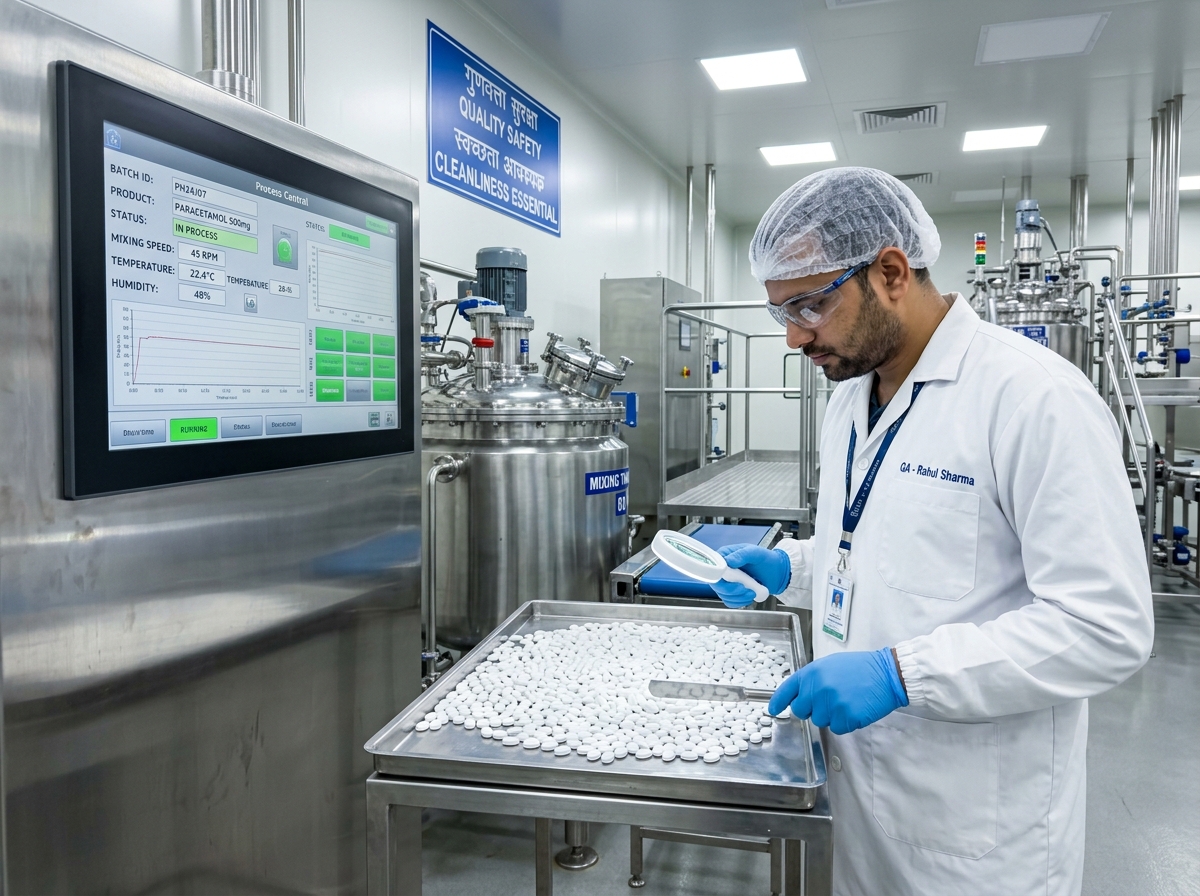
Critical Parameter Tracking
Monitor critical process parameters (CPP) and critical quality attributes (CQA) dynamically across production batches.
CPP & CQA Maps
Map critical inputs and outputs for every product recipe.
APQR Templates
Generate Product Quality Reviews automatically using pre-built templates.
Deviation Flags
Flag process parameter excursions for immediate quality review.
Audit Log Integrity
Secure all data entries with 21 CFR Part 11 compliant audit trails.
E-Signatures
Collect digital signatures from quality and operations managers.
Batch Capability
Calculate process indices (Cpk, Ppk) across batches for APQR documentation.
APQR-2026: Tablet Formulation B3
6-Step Process Verification
Specify critical parameters, ingest batch telemetry, run statistics, detect trends, compile APQR files, and verify compliance.
Parameters Mapping
Identify Critical Process Parameters and Critical Quality Attributes for each product.
Configure CPV Plan
Map critical parameters and set up verification rules for new production campaigns.
Recipe Mapping
Configure parameter limits based on approved product recipes.
Historian Connections
Connect parameters directly to historian variables for auto-capture.
Audit Trail Enforced
Track all plan changes automatically in a compliant register.
Template Duplication
Copy verification settings from active plans to speed up configurations.
CPV Plan Configuration
Select Product Recipe
Tablet Formulation B3
Map Critical Parameters
Link CPP/CQA variables to historian tags
Publish Validation Rules
Publish limits and audit trail rules
APQR Schedule Tracker
Review DueTablet Formulation APQR Review
Batches run in Q2 2026 • Quality Assurance team
Liquid Suspension CPV Review
Review limits after raw material update • Process team
APQR Schedule Alerts
Establish calendars to ensure annual product quality reviews and validation checks are completed on schedule.
Due Date Alerts
Send automated notifications to quality teams when reviews are due.
Escalation Logic
Escalate pending reviews to QA directors if deadlines are missed.
Progress Dashboard
Monitor report compilation progress from draft through approval.
Calendar Integration
Sync verification timelines with quality schedules.
Critical Parameter Excursion
Log instances where process parameters exceed validation limits, triggering deviation workflows.
Deviation Workflows
Guide quality engineers through troubleshooting and investigation steps automatically.
Batch Containment
Quarantine affected batches automatically in warehousing systems.
Telemetry Captures
Capture variable history surrounding parameter deviations.
Audit trail compliance
Log containment, comments, and approvals in a secure log.
Quality Deviation File
DEV-2026-302CPP Limit Excursion Detected
Aug 13, 2026 • 11:38 AM16.2 kN
Excursion Value (Max 15)12 min
DurationDetails
Compression force exceeded the Critical Process Parameter limit (15 kN) during Batch #1292. Excursion logged to quality deviation system.
Quality RCA File
RCA-DEV-3025 Whys Trace
Batch Excursion Investigation
Investigate critical process deviations, identify root causes, and log CAPA resolutions.
Linked Investigations
Link investigations, batch files, and CAPA logs for full trace.
5 Whys Logging
Log structural explanations next to process variable trend charts.
CAPA Integration
Generate tool maintenance tasks directly from root causes.
Insight Database
Search past RCA records to resolve similar process anomalies.
Supported Validation Formats
Utilize standard validation formats to ensure compliance with global regulators.
Annual Product Quality Review (APQR)
Compile batch data, deviations, and trends into annual summary reports.
Continuous Process Verification (CPV)
Monitor critical process parameters (CPP) and attributes (CQA) continuously.
Product Quality Review (PQR)
Prepare quality reviews in compliance with EU Annex 11 guidelines.
Validation Reports
Generate report formats for FDA 21 CFR Part 11 and WHO Annex 4 audits.
Connected Regulatory Hub
Connect validation reports with batch records, lab systems, and compliance registers.
Batch Records
Extract batch run profiles and operator logs automatically.
LIMS Platforms
Pull laboratory quality records and release chromatography reports automatically.
CAPA Registers
Link quality deviations directly with active corrective actions.
Secure Archives
Archive validation records with electronic signatures and audit trails.
Clear outcomes for periodic quality review.
Keep the evidence needed for periodic quality conversations in one place.
Connect observations, exceptions, and follow-up actions.
Reduce time spent assembling recurring process-quality reports.
Built for teams that need this to just work.
Who this is for
- QA and regulatory affairs teams preparing for inspections and audits.
- Process engineers responsible for CPV monitoring and statistical validation.
- Plant quality managers compiling APQRs for batch release reviews.
- Pharma manufacturers looking to transition from manual, months-long annual review sprints to a continuously-updated record.
The operational building blocks your team needs.
Each implementation is configured around your process, decision points, and evidence requirements — not a generic software rollout.
Verification plans
Define critical process and quality parameters with consistent monitoring rules.
Review-ready records
Organise product and process evidence for periodic quality review without chasing files.
Trend management
Surface recurring deviations, investigations, and actions across batches and products.
From the shop floor to the leadership view.
The solution is designed to fit the people, systems, and controls already operating in your plant.
CPP/CQA excursion alerts
Automatically route critical parameter excursions to the responsible process engineer for immediate assessment.
Batch record compilation
Seamlessly compile batch run logs, deviations, and laboratory results into the draft APQR record.
E-signature closure
Execute secure 21 CFR Part 11 compliant digital signatures to lock and close completed reviews.
Frontline quality context
Give operators line-side visibility into control limits and parameters as they run.
Validation monitoring
Compare batch capability metrics (Cpk, Ppk) across lines to confirm validation status.
Multi-site quality governance
Track compliance status and report completeness across all manufacturing sites.
A repeatable path, every time.
Discover (Weeks 1–2)
Map critical parameters (CPP/CQA) and identify the current quality review and APQR cadence.
Configure (Weeks 3–5)
Set up CPV plans, validation rules, and APQR document templates tailored to your product portfolio.
Pilot (Weeks 6–10)
Run live continuous process verification monitoring and draft the first APQR on a single product line.
Scale (Weeks 11+)
Extend CPV monitoring to the full product portfolio and coordinate a multi-site rollout.
Industrial technology your operation can rely on.
We combine industrial data, connected workflows, and secure integrations to make this solution practical for real plant operations.
Batch Record Integration
Production logs
LIMS Connectivity
Laboratory results
CPP/CQA Parameter Mapping
Parameter binding
The questions we hear most.
How is this compliant with 21 CFR Part 11?+
The system enforces strict electronic signatures, permanent tamper-evident audit trails with change-reason logs, secure user access controls mapped to Active Directory, and structured electronic records that ensure full ALCOA+ data integrity compliance.
Can this generate our actual APQR document, or just the underlying data?+
It does both. The platform continually gathers and structures your process quality data, and provides pre-built templates to compile the final APQR report drafts—including batch lists, deviations, Cpk trends, and e-signature logs—ready for QA review.
How does this connect to our LIMS and batch record systems?+
We connect to LIMS databases and historian databases (like OPC UA or SCADA) via secure APIs or structured data exports. This automates the retrieval of Critical Quality Attributes (CQAs) and Critical Process Parameters (CPPs) without manual copy-pasting.
What happens during an inspection — can auditors get direct read access?+
Yes. You can configure read-only guest roles specifically for auditors during inspections. They can directly search change records, view time-stamped audit trails, check parameter capability charts, and inspect approved validation history.
How long does it take to get our first product's CPV plan live?+
A typical pilot configuration takes 6–10 weeks. This includes mapping your CPPs and CQAs, establishing system integrations, configuring validation limits, and running a test batch cycle to verify compliance checks.
Most engagements span more than one practice.
Free consultation
Turn Your Vision
Into Reality


Ready to scope this in detail?
A 30-minute call with a senior engineer. No sales theatre — just a real assessment of fit, scope, and timeline.