
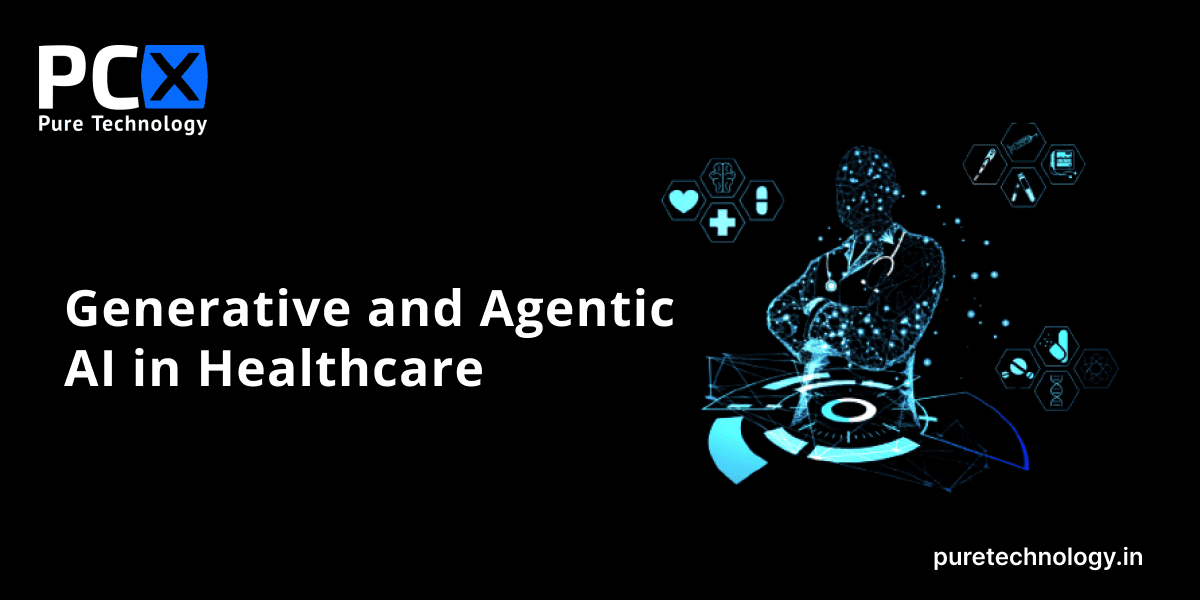
The Future of Healthcare 2030: How Generative and Agentic AI Will Redefine Patient Care
The last decade has already shown us how rapidly healthcare can evolve, with digital innovations reshaping everything from diagnostics to patient care. But the next wave—driven by Generative AI and Agentic AI—will transform the sector in ways that will redefine how healthcare is delivered, experienced, and managed. By 2030, expect a healthcare ecosystem that is smarter, faster, and deeply personalized.
From Traditional AI to Agentic AI: A New Paradigm
Traditional AI in healthcare has been largely reactive—processing data, generating predictions, or automating routine tasks. In contrast, Agentic AI is proactive, capable of anticipating needs, making autonomous decisions, and taking intelligent actions across systems.
- Traditional AI → Solves problems after they occur.
- Agentic AI → Anticipates issues, makes informed choices, and executes actions autonomously.
This shift means healthcare will move from a fragmented system to one that is intelligent, adaptive, and patient-centric.
The Four-Step Model of Agentic AI in Healthcare
- Situational Awareness
Collects real-time data from sensors, APIs, and medical records to create a full clinical picture. - Strategic Reasoning
Uses large language models (LLMs) and advanced techniques like retrieval-augmented generation (RAG) to determine the best course of action. - Autonomous Execution
Executes tasks—such as booking consultations, updating records, or adjusting care plans—without human intervention, while monitoring outcomes. - Continuous Adaptation
Learns and evolves through feedback loops, making the system smarter and more precise with every interaction.
Key Transformations in Healthcare by 2030
1. Smarter Doctor-Patient Interactions
Generative AI will automate documentation, summarize key medical points, and update charts instantly. Doctors will spend less time typing and more time connecting with patients.
2. Continuous Health Monitoring
Agentic AI will transform passive monitoring (like fitness trackers) into active care systems that detect anomalies and proactively recommend actions.
3. Hyper-Personalized Treatments
Generative AI will analyze genetics, lifestyle, and environmental data to create tailored treatment plans. Imagine diets personalized to your microbiome or therapies designed for your unique biology.
4. Enhanced Clinical Decision-Making
AI will act as a “co-pilot” for clinicians—flagging rare conditions, cross-checking cases with global databases, and suggesting alternative diagnoses.
5. Preventive Healthcare Becomes Mainstream
AI will shift focus from “sick care” to well care, predicting risks before they surface. For example, AI may recommend a preventive cardiology visit if your wearables show early heart strain combined with family history.
6. Accelerated Drug Discovery
Agentic AI will simulate how new compounds interact with virtual patient models, cutting drug development time dramatically and making treatments available faster.
7. Unified Care Coordination
AI-powered platforms will merge data from multiple providers, ensuring doctors access complete patient records in real-time, enabling seamless collaboration.
8. Patient Empowerment Through AI Dashboards
By 2030, patients will use AI-driven health dashboards that explain medical data in simple language, helping them make informed decisions and take control of their health journey.
Strategies for Successful AI Adoption in Healthcare
- Focus on high-impact automation: Start with repetitive tasks like scheduling and intake.
- Define clear objectives: Set measurable goals, whether reducing wait times or improving patient satisfaction.
- Centralize data systems: Unified records improve AI accuracy and decision-making.
- Refine continuously: Use real-world feedback to adapt AI systems to evolving healthcare needs.
Conclusion: The Future of Healthcare Is Intelligent and Personalized
By 2030, healthcare will no longer be defined by inefficiencies, fragmented records, or reactive treatments. Instead, Generative AI will power data analysis and knowledge creation, while Agentic AI will take the lead in decision-making and autonomous execution.
From personalized treatments and proactive monitoring to faster drug discoveries and patient empowerment, the healthcare industry will undergo a transformation unlike any before.
The challenge for healthcare organizations lies in building robust data infrastructure, ensuring ethical AI adoption, and earning patient trust. Those who succeed won’t just adopt new technologies—they will lead the charge into a future where healthcare is proactive, intelligent, and truly patient-first.
Call us for a professional consultation








Leave a Reply