
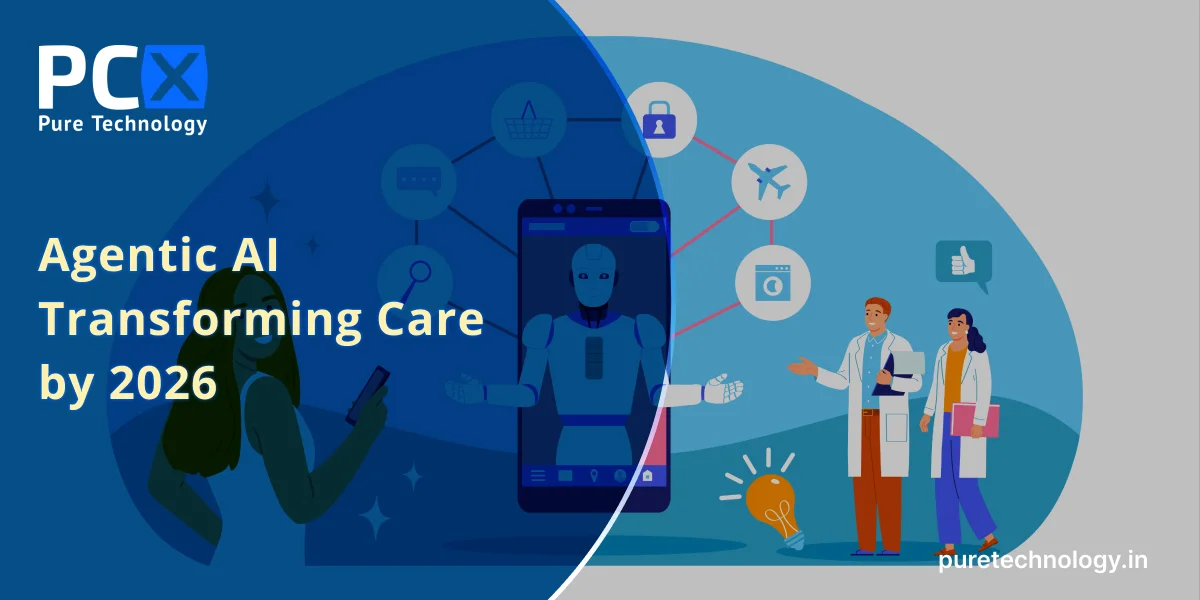
Agentic AI: Transforming Care by 2026
Introduction
Agentic AI is emerging as a revolutionary force in healthcare—moving beyond traditional automation to systems that can make decisions, adapt to situations, and independently execute medical tasks. Unlike standard AI models that require constant human prompts, Agentic AI systems operate as autonomous agents capable of coordinating workflows, predicting outcomes, supporting clinicians, and improving patient experiences. As we move toward 2026, this technology is set to redefine care delivery with precision, efficiency, and real-time intelligence.
Types of Agentic AI in Healthcare
1. Diagnostic Agents
AI agents that analyze imaging, lab data, clinical notes, and medical histories to identify diseases early and improve diagnostic accuracy.
2. Care Coordination Agents
Autonomous systems that schedule appointments, manage patient journeys, track progress, and ensure adherence to treatment plans.
3. Predictive Health Agents
Predict health risks using patient data and environmental or lifestyle patterns to enable proactive care and timely interventions.
4. Treatment Optimization Agents
Agents that recommend personalized treatment options based on genetics, past responses, allergies, and patient-specific biomarkers.
5. Administrative Agents
Designed to reduce backend workload by automating billing, insurance validation, documentation, and EHR updates.
Key Trends Shaping Agentic AI in Healthcare
1. Autonomous Clinical Support
Hospitals are deploying AI agents capable of triaging patients, monitoring vitals, and generating clinical insights without manual oversight.
2. Multi-Agent Hospital Ecosystems
Healthcare systems are building interconnected AI agents that collaborate across departments—from diagnostics to pharmacy to ICU management.
3. AI-Driven Personalized Medicine
Advanced agents tailor treatments based on patient genomes, lifestyle indicators, and real-time physiological responses.
4. Enhanced Remote Patient Monitoring
Wearables, sensors, and home-based devices now work with AI agents to track health continuously and alert providers instantly.
5. AI-First Healthcare Operations
By 2026, hospitals are expected to adopt “AI-first operations,” where autonomous agents manage scheduling, resource allocation, and workflow optimization.
Forecast for 2026
1. 60% of Hospitals to Deploy Agentic AI Systems
Healthcare facilities will increasingly rely on AI agents to streamline diagnostics, monitoring, and patient communication.
2. $12–15 Billion Market Growth
Agentic AI adoption in medical systems, biotech, pharmacy automation, and patient management will drive rapid economic expansion.
3. 40% Reduction in Operational Burden
AI agents will take over routine administrative tasks, reducing clinician burnout and freeing staff for patient-centric care.
4. 2x Improvement in Early Detection Rates
Predictive and diagnostic agents will enhance disease detection, particularly for chronic and life-threatening conditions.
5. Rise of AI-Enabled Home Hospitals
Agentic health agents will support remote treatment, vitals tracking, and personalized care—bringing hospital-level services to homes.
Conclusion
Agentic AI is set to become one of the most transformative forces in global healthcare by 2026. From optimizing diagnostics to enhancing patient management and streamlining hospital operations, these autonomous, intelligent systems will elevate care quality and make healthcare more accessible, efficient, and proactive. As hospitals adopt multi-agent ecosystems and AI-first strategies, the future of medical care will be shaped by precision, autonomy, and continuous innovation.
Call us for a professional consultation










Leave a Reply